
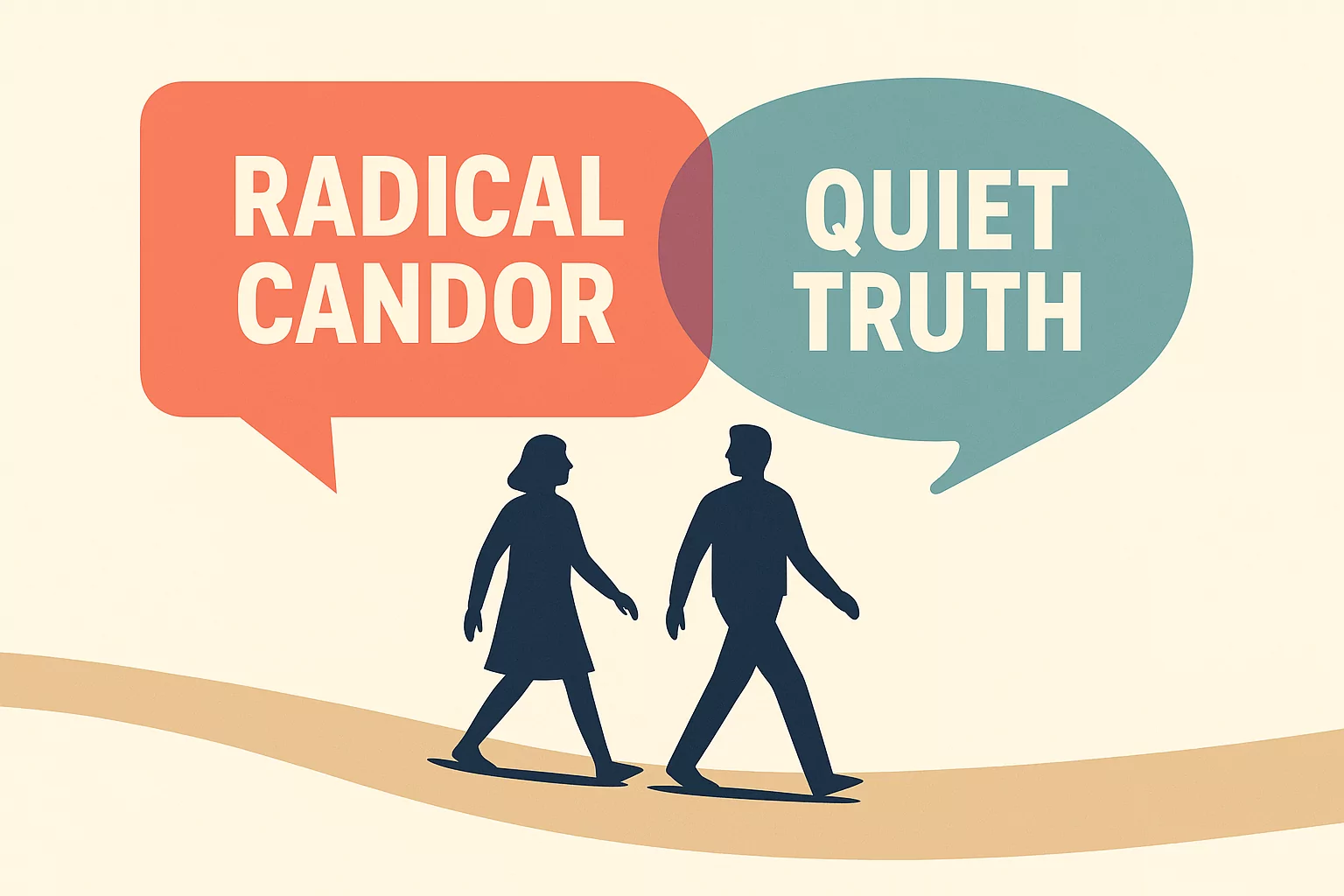
Prelude: The Walk That Saved Us.. a disaster story
Many years ago I sat with a teammate and laid out that their performance was affecting others—I even repeated the vague “people have commented.” The facts were accurate, but my framing was disastrously wrong: rather than lighting a path forward, I injected distrust. They felt blindsided, betrayed, and suddenly unsure whose voices to trust. It was a textbook example of how not to give feedback.
Seeing the damage, we left the building and walked—miles—talking the whole way. By the time our feet were sore, we had rewound the scene and re‑cut it as a partnership plan, not a public indictment. That blister‑filled trek still reminds me that the right facts in the wrong wrapping can cripple a relationship before it ever has a chance to run.
Lesson learned: As The Courage to Be Disliked argues, leadership isn’t a popularity contest—clarity without care backfires, but care without clarity does too.
The Feedback Spectrum
Neither blunt candor nor hushed politeness owns the moral high ground. Think of feedback as a fader, not a light switch. Kim Scott’s Radical Candor gives us the map:
| Zone | Tone | Best For | Primary Risk |
|---|---|---|---|
| Radical Candor | Direct, high‑volume | Crisis pivots, safety issues | Emotional sting |
| Quiet Truth | Calm, invitational | Skill coaching, early course‑correction | Message dilution |
| Ruinous Empathy | Warm, evasive | Morale boosts | Stagnation |
| Obnoxious Aggression | Sharp, impersonal | Short‑term compliance | Trust erosion |
Your job isn’t to camp in one box; it’s to slide the fader to match relationship equity, urgency, and audience readiness. Radical Candor is the clutch you engage when the stakes are existential and the relationship can bear the torque; Quiet Truth is the gear you shift into when finesse trumps force. Mastery lies in feeling the road and changing gears without grinding—this is how you keep momentum while protecting the engine of trust.
Choosing Your Moment (A Situational Lens)
Before you push the candor throttle, read the cockpit. The authors of Crucial Conversations remind us: “If it’s not safe, you can’t stay in dialogue.” Four situational dials tell you whether to roar or whisper:
- Relationship equity – Have you deposited enough “care credits” to afford a hard withdrawal?
- Context pressure – Is the house on fire, or are we debriefing lessons over coffee?
- Audience readiness – Sprinting to a deadline ≠ sitting in reflection mode.
- Cultural norms – In some rooms straight talk = respect; in others it = revolt.
Pro‑tip: If more than two dials glow red, start with Quiet Truth and work up as safety grows.
Delivering Honesty Without Collateral Damage
Borrowing from the “STATE My Path” model in Crucial Conversations and the listening frameworks in Thanks for the Feedback, here’s a seven‑step cadence that keeps candor constructive:
- Check motive – If the goal is to score a point, pause. If it’s to lift the work, proceed.
- Secure permission – “Mind if I share an observation?” primes receptivity.
- Name the evidence – Describe behaviour, not character.
- Surface the impact – Connect action to team or business consequences.
- Invite response – “How does that land?” then listen. (Stone & Heen call this “switching on your learning stance.”)
- Co‑craft one next step – Turn insight into an actionable micro‑commitment.
- Reaffirm respect – Close with belief in their capability, not a lecture on their flaws.
► Side‑note on emotion: No Hard Feelings teaches that feelings are data, not disruption. Label your own (“I’m concerned…”) to drop the temperature and model emotional precision.
These steps flex: amp them up for Radical Candor; soften the edges for Quiet Truth.
Culture Compounds (Why This Matters Beyond One Conversation)
Teams that normalise micro‑feedback avoid yearly demolition jobs. High‑safety cultures also outperform peers on performance and retention—because people spend energy shipping value, not decoding tone. That echoes the “whole‑curve” philosophy I laid out in Real Leaders Grow People—Not Just Teams and aligns with No Hard Feelingsevidence that emotion‑smart environments crush burnout without sacrificing results.
Micro‑Practices You Can Try Monday
Small hinges swing big doors. If candor is a muscle, these micro‑practices are your daily reps—quick enough to squeeze between meetings, potent enough to shift culture. Pick one to trial this week; by next Monday you’ll have evidence that honesty can be lightweight yet transformative.
| Practice | What You Do | Cadence |
|---|---|---|
| Feedback Friday | Block 30 min to send two notes: one thank‑you, one growth nudge | Weekly |
| Two‑Minute Loom | Record a quick screen‑share critique; tone > text | Ad‑hoc |
| Stop‑Start‑Continue | Ask the team to give you the trio first (see Thanks for the Feedback for prompts) | Sprint retros |
| Shadow‑Lead Debrief | Junior shadows meeting & gives feedback on you | Quarterly |
Start with one practice, commit for a month, then layer in another. Culture change isn’t a hackathon; it’s interval training—consistency beats intensity every time.
Final thoughts
Candor and Quiet Truth are two edges of the same blade—one cuts swiftly, the other precisely. Being all in means wielding the right edge at the right time, anchored by personal accountability and shared success—the same backbone that runs through our manifesto for sustainable greatness. When honesty serves the other, it rarely lacerates; it lands—and it lifts.
Next step: Pair up with a colleague, pick any one of these five books, and buddy‑read a chapter a week. Discuss it during “Feedback Friday.” You’ll sharpen both sides of the blade—together.
Further Resources
Books
- Radical Candor — Kim Scott
- Crucial Conversations — Kerry Patterson, Joseph Grenny, Ron McMillan & Al Switzler
- Thanks for the Feedback (radicalcandor.com) — Douglas Stone & Sheila Heen
- No Hard Feelings — Liz Fosslieny (cruciallearning.com)
- The Courage to Be Disliked — Ichiro Kishimi & Fumitake Koga
Blogs & Radical Candor Blog & Podcast Hub
- Crucial Conversations Reader Resources & Blog — free tools and article (simonandschuster.com)
- “What Is Psychological Safety?” — Amy Gallo, Harvard Bus(radicalcandor.com))
YouTube (hbr.org)
- “Radical Candor in 6 Minutes” — Kim Scott
- Joseph Grenny on Crucial Conversations(hbr.org)
- “Thanks for the Feedback” full talk
Leave a Reply